How to Finally Finish Your Book (Even When You Keep Getting Stuck)

Many people dream of writing a book. They have ideas, notes, outlines, and maybe even a few chapters started. But finishing the book? That’s where most writers get stuck.
The truth is, writing a book is not just about inspiration. It’s about structure, discipline, and a clear process.
Over the years, I’ve written multiple books and helped others develop their ideas into finished manuscripts. What I’ve discovered is that most writers don’t fail because they lack talent. They struggle because they lack a system.
That’s why I developed a framework that helps creators move from ideas to completed work.
If you’ve been trying to finish your book, these steps will help you finally cross the finish line.
Stop Waiting for Motivation

One of the biggest mistakes writers make is waiting until they feel ready to write.
Motivation is unreliable.
I learned that early in my career. You can’t wait for the right conditions, the right mood, or the right moment. If you do, the book never gets written.
Professional writers don’t depend on motivation. They depend on routine and momentum.
So instead of asking yourself whether you feel inspired today, ask yourself this:
“What small part of my book can I move ahead today?”
Sometimes that means writing a full chapter. Sometimes it means outlining the next scene or cleaning up a paragraph you’ve been avoiding. The size of the step doesn’t matter as much as the fact that you took it.
Progress is progress.
Build a Simple Writing System

Most unfinished books fail because the process feels overwhelming.
When you sit down and think about writing an entire book, your brain starts to resist. The project feels too big, too complex, too uncertain. So you do something else instead.
The fix is simple: stop trying to write a book and start working through a process.
Break the project into manageable pieces.
Your process might look something like this: idea, outline, chapter drafts, editing, revision. When you treat each stage as its own project, the work becomes easier to manage. You always know what you’re supposed to be doing and where you’re headed next.
In my own writing process, I rely on a framework I call CLEAR Work. It’s a system that helps creators move from concept to completion with intentional progress at every step.
The goal is not perfection. The goal is forward motion.
Write Before You Edit
Here is a trap that catches almost every writer at some point: editing too early.
You slow yourself down when you go back and edit during the drafting phase. This kills your momentum. You get stuck on one paragraph, one sentence, one word. Meanwhile, the rest of the chapter never gets written.
Your first draft should have one job. Get the story or the ideas out of your head and onto the page. That’s it.
You can always improve your writing later. But you can’t improve something that doesn’t exist yet.
A finished rough draft is far more valuable than a polished chapter that never leads anywhere.
Give yourself permission to write badly. That’s how good books get made.
Create Deadlines That Matter

Most writers never finish their book because there is no real deadline.
When there’s no timeline attached to a project, it’s easy to treat it as a dream rather than a commitment. You keep it in the back of your mind. You always plan to get to it. But you always find other things to handle first.
When you give yourself a real deadline, something shifts. Your brain begins to treat the project like it actually matters.
Start small. Write 500 words per day. Finish a chapter each week. Finish your first draft within 90 days.
Small deadlines build consistency.
Consistency builds completed books.
Focus on Finishing, Not Perfecting
Many great books never get published because the writer keeps trying to make them perfect.
I understand that impulse. When you care about something, you want it to be right. But perfectionism at the wrong stage of the process is just procrastination with better branding.
The goal of your first book is not perfection.
The goal is completion.
Finishing your first book teaches you lessons that no writing course ever could. No coach or article like this one can impart these lessons. You learn how you work. You learn what your writing process actually looks like, not what you imagined it would look like. You learn how to push through the hard middle of a project when the excitement has worn off.
And once you finish one book, the next becomes much easier.
A Framework That Helps Writers Finish
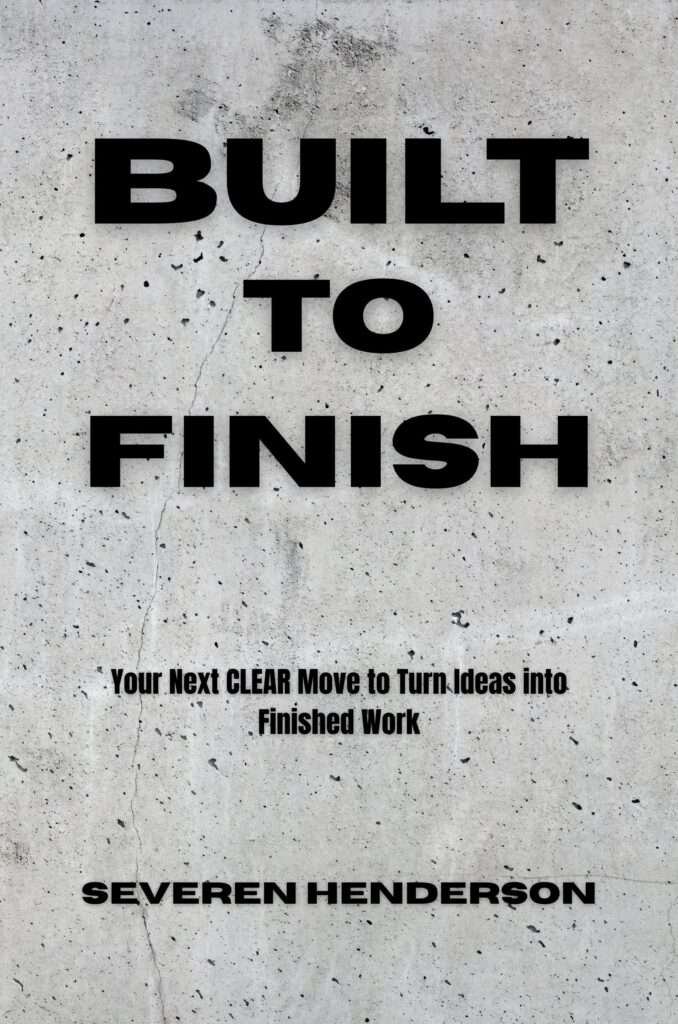
One of the reasons I wrote Built to Finish was because I kept seeing the same pattern. Talented people, solid ideas, and unfinished projects collecting dust on their hard drives.
The book introduces the CLEAR framework. It is a system designed to help creators move from ideas to completed work. Structure and accountability are built into every step. It’s not a magic formula. It’s a repeatable process.
Writing a book is not just about creativity. It’s about building habits that allow your ideas to reach the finish line.
If you’ve been stuck on an unfinished project, the principles behind CLEAR Work can help. They help you find your footing and start moving again.
Start Today

Every finished book begins the same way: with someone deciding to keep going even when the process feels slow.
You don’t need perfect conditions to write your book. You don’t need a dedicated office, the right software, or a three-month sabbatical. You need consistency, structure, and the willingness to keep moving ahead.
Start where you are. Write what you can today.
And remember that the difference between people who dream about writing books and those who actually publish them often comes down to one simple thing:
They finished.